Despite the powers to be narrating about modal shift in terms of our obligations towards emission reductions / climate change, “Vision Zero” / “Road to Zero” (where no deaths / serious injuries occur on transport), and congestion reduction – The initiatives to encourage people out of cars and on to Public Transport and Active modes at least in Auckland have not been adequate. Frankly the constant policy narratives don’t match the action on the part of our powers to be.
There are a few major things playing against modal shift in Auckland. These include…
- Auckland Council (possibly pressured by Central Government to do so) approving greenfield subdivisions with no access to public transport. The only way to get in out of those neighbourhoods would be to drive a car. Of course, new residents moving into those developments will need to buy a fleet of cars, and it’s no guess where those cars are going to end up – Adding more cars to an already over saturated and congested region wide roading network. We see this occurring in the South East area of Auckland in Ormiston and Flatbush where Ti-Rakau Drive suffers from some of the most severe congestion in the region. A major issue is once travel patterns are set, it then becomes that much more difficult to get people to leave their cars at home and adopt alternatives.
- Constant Rail system incidents that cause train cancellations. Even with the Central Rail Link up and running, the system simply lacks the needed redundancy and resilience elsewhere to property absorb these incidents, so the constant rail service disruptions are sadly likely to continue at their current cadence. For people to leave these cars at home, they need to be able to depend on the system when they need it. The lack of reliability represents a multi-agency failure to deliver this
I’m of the opinion that unless you go into the Auckland CBD or you are lucky enough to be on a direct Public Transport route. Public Transport as it’s structured today isn’t going to meet the needs of many if not most commuters.
In terms of my own situation…
I work in East Tamaki in an I.T. / Software development role. To get from my home near Meadowbank Shopping centre to my work place in Kerwyn Avenue, East Tamaki Industrial, I would need to take a minimum of 3 buses with a travel time of 1.5 hours each way. Sure, you can fritter away on your phone for that time or simply look out the window and observe the world go by, but with the number of transfers. It’s no soon you have to remember to push the bus stopping buzzer, prepare to alight and look out for the next service to catch.
Car takes around 25 minutes in (Morning) and about an hour to get back (Afternoon). However, the travel time is increasing each year as more people move to Auckland resulting in increased traffic volumes in already saturated roads. Agencies and councilors are championing the Eastern Busway as some transformational thing… It is not. Unlike the Northern Busway, the Eastern Busway is full of “at grade” intersections at arguably very busy intersections.
I’ve tried to use public transport for most other journeys, particularly in the weekends. It works Okay if you’re not in a hurry to get any where, but have found it’s still quicker to drive. This applies even for busy events (festivals) where it’s quicker to drive, park up further out and walk to the event.
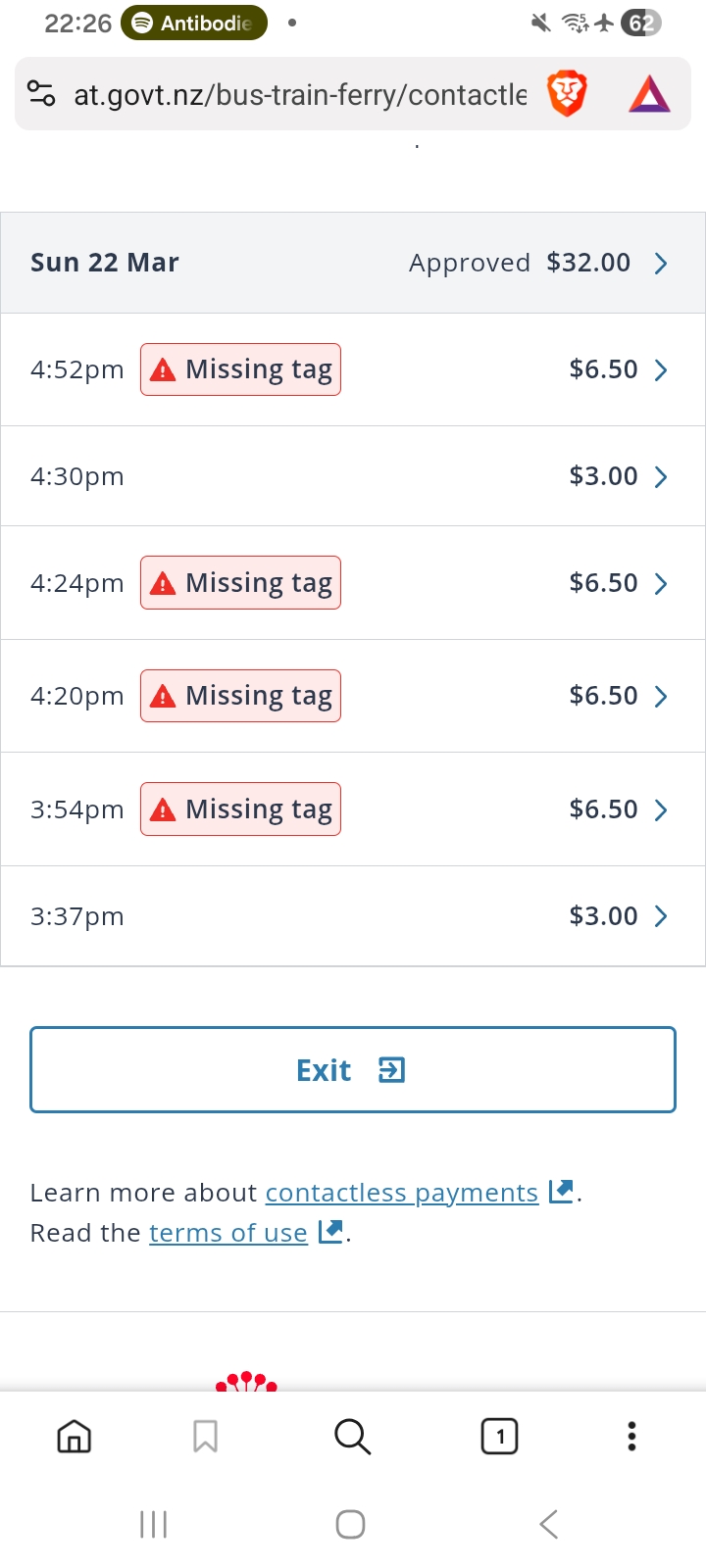
The final nail in the coffin for me has been the frequent enough cascading “missing tag” errors when paying for public transport.
In conclusion…
Given the current trajectory and the competing incentives even within Auckland Council itself. I’m not confident that Auckland will meaningfully ween itself off of Car dependency / Car-centricity for the foreseeable future, at least not in the next few decades. This is caused by a multi-agency failure to work together and deliver for the public.